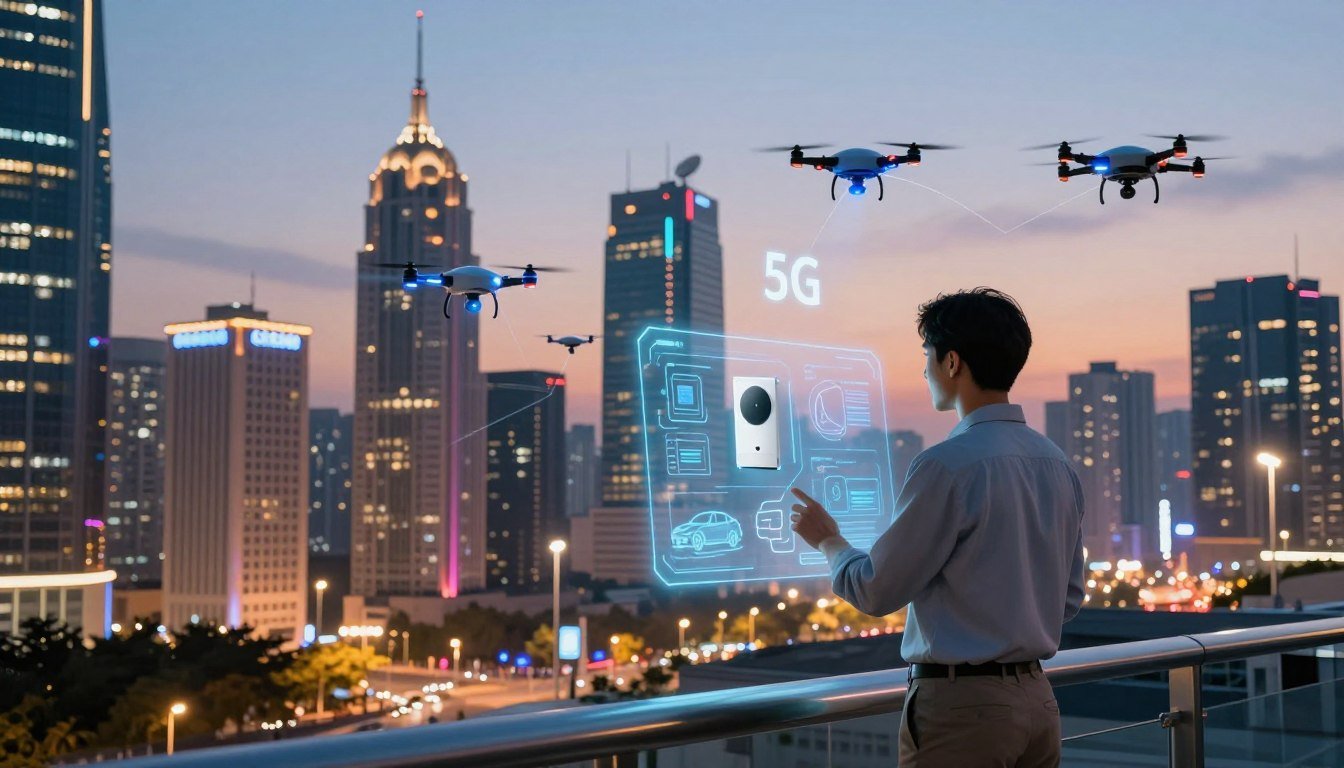
Experts predict that more than 50 billion smart devices will connect to global networks by 2030. This massive surge requires a robust infrastructure capable of handling unprecedented data traffic. High-speed wireless networks serve as the essential foundation for this digital evolution.
How Does 5G Technology Enhance the Capabilities of the Internet of Things (IoT)
Transitioning from older cellular standards to modern fifth-generation systems provides the bandwidth necessary for billions of simultaneous connections. This shift allows machines to communicate in real-time with remarkable precision. By understanding these foundational improvements, we gain a clear perspective on why this advancement acts as the backbone for modern digital transformation.
Key Takeaways
- Fifth-generation networks support massive device density in urban environments.
- Ultra-low latency enables instantaneous communication between smart sensors.
- Increased bandwidth facilitates seamless data transfer for complex industrial systems.
- Energy efficiency improvements extend the battery life of remote hardware.
- Reliable connectivity ensures consistent performance for critical infrastructure applications.
Core Technical Advantages of 5G for IoT
Two primary technical advancements are currently reshaping how devices communicate across the United States. These innovations provide the backbone for modern digital ecosystems, ensuring that data flows efficiently between hardware and cloud servers. By leveraging 5g technology benefits iot, companies can now deploy solutions that were previously impossible due to bandwidth or latency constraints.
Ultra-Reliable Low Latency Communication (URLLC)
URLLC is designed for mission-critical applications where every millisecond counts. This feature ensures that data transmission is nearly instantaneous, which is vital for remote surgery, autonomous vehicles, and real-time industrial control systems. When reliability is non-negotiable, this technology provides the stability required to prevent system failures.
“The true power of 5G lies in its ability to provide deterministic performance for the most demanding industrial tasks, effectively bridging the gap between physical machinery and digital intelligence.”
Massive Machine-Type Communications (mMTC)
While URLLC focuses on speed, mMTC addresses the challenge of scale. It allows networks to support a massive density of connected devices in a single square kilometer without losing signal integrity. These iot advancements with 5g are essential for smart cities that rely on thousands of sensors to monitor traffic, air quality, and energy consumption simultaneously.
The following table highlights the distinct roles these two pillars play in modern network architecture:
| Feature | URLLC | mMTC |
| Primary Goal | Latency Reduction | Device Density |
| Key Use Case | Autonomous Systems | Smart City Sensors |
| Reliability | Extremely High | High Efficiency |
| Data Volume | Low to Medium | Very Low |
Businesses looking to expand their footprint must understand how these features integrate into their existing workflows. By utilizing the right technical framework, organizations can ensure their infrastructure remains resilient as they scale. Ultimately, these iot advancements with 5g empower developers to build smarter, more responsive environments for users everywhere.
How Does 5G Technology Enhance the Capabilities of the Internet of Things (IoT)?
The impact of 5g on iot capabilities is reshaping the way we interact with our physical surroundings. By providing faster data speeds and lower latency, this network standard allows devices to communicate with near-instantaneous precision. This shift is not just about speed; it is about creating a more responsive and intelligent ecosystem for everyone.
Transforming Smart Cities and Infrastructure
Modern urban centers are becoming more efficient by deploying thousands of interconnected sensors. These devices monitor traffic patterns in real-time, allowing city planners to adjust signal timings to reduce congestion. Furthermore, smart grids use this connectivity to balance energy loads, which significantly lowers waste across metropolitan areas.
Advancing Industrial Automation and Robotics
In the manufacturing sector, enhancing iot with 5g technology enables a new level of machine coordination. Robots on the factory floor can now share data instantly, allowing for synchronized movements that were previously impossible. This level of connectivity ensures that production lines remain fluid and highly adaptable to changing demands.
Real-Time Predictive Maintenance
Industrial equipment often suffers from unexpected downtime, which costs companies millions annually. With 5G, sensors can transmit vibration and temperature data to cloud platforms without delay. This allows maintenance teams to predict failures before they happen, keeping operations running smoothly.
Enhanced Supply Chain Visibility
Tracking goods across the globe requires reliable and constant data streams. 5G provides the bandwidth necessary to monitor shipments with high-definition tracking and environmental sensors. Organizations gain total transparency, ensuring that products arrive on time and in perfect condition.
| Feature | 4G Networks | 5G Networks |
| Latency | 30-50 milliseconds | Under 5 milliseconds |
| Device Density | Low capacity | High capacity (1M/km²) |
| Reliability | Standard | Ultra-reliable |
| Energy Efficiency | Moderate | High (optimized) |
Conclusion
The rapid evolution of digital networks marks a turning point for global industry. We stand at the threshold of a new era where the future of iot and 5g technology dictates how businesses operate and scale. This shift promises to redefine efficiency across every major sector.
Companies that prioritize robust 5g connectivity for iot devices gain a distinct edge in a crowded marketplace. These organizations can process massive data streams in real time to make smarter decisions. Such agility remains vital for maintaining growth in an automated economy.
Leaders at firms like Verizon and Ericsson continue to push the boundaries of what these networks can achieve. Their work ensures that smart cities and automated factories function with peak precision. Investing in this infrastructure today prepares your business for the demands of tomorrow.
Take a moment to evaluate your current digital strategy against these emerging standards. Consider how your team might leverage high-speed networks to solve complex operational challenges. Your commitment to modernizing systems will define your success in the coming decade.
FAQ
How does 5G technology enhance the capabilities of the Internet of Things (IoT)?
5G provides the critical infrastructure needed to handle the massive data loads generated by connected devices. By offering ultra-low latency and high-speed data transfer, 5G allows devices to communicate almost instantaneously. This enables complex systems, such as Tesla’s autonomous driving features or Siemens’ industrial automation platforms, to operate with a level of precision and speed that was simply impossible with 4G technology.
What are the most significant 5G technology benefits for IoT deployments?
One of the primary 5G technology benefits for IoT is the ability to support a much higher density of devices. While 4G could struggle in crowded areas, 5G can support up to one million devices per square kilometer. This capacity is essential for companies like Verizon and AT&T as they roll out large-scale smart city initiatives, ensuring that every sensor—from traffic lights to water meters—remains consistently connected.
How are IoT advancements with 5G changing the manufacturing industry?
IoT advancements with 5G are driving the rise of “Industry 4.0.” By utilizing Ultra-Reliable Low Latency Communication (URLLC), manufacturers like Bosch and General Electric can deploy wireless robots that react in real-time. This connectivity supports real-time predictive maintenance, allowing sensors to detect equipment fatigue and schedule repairs before a breakdown occurs, saving millions in potential downtime.
What is the impact of 5G on IoT capabilities in urban environments?
The impact of 5G on IoT capabilities is transformative for smart cities. High-bandwidth 5G networks allow urban planners to integrate massive amounts of data from environmental sensors and public safety cameras. For instance, the city of San Diego has utilized high-speed connectivity to optimize energy consumption across its street lighting, demonstrating how enhancing IoT with 5G technology leads to more sustainable and efficient metropolitan living.
How does 5G connectivity for IoT devices improve supply chain management?
5G connectivity for IoT devices provides unprecedented visibility across the entire logistics chain. Companies like Amazon and FedEx use 5G-enabled trackers to monitor the location, temperature, and humidity of goods in real-time. This level of granular data ensures that sensitive shipments, such as pharmaceuticals or perishable food, reach their destination in perfect condition, reducing waste and improving customer trust.
What should businesses expect from the future of IoT and 5G technology?
The future of IoT and 5G technology will see a move toward complete digital immersion. As 5G networks become more ubiquitous, we will see the expansion of edge computing, where data is processed closer to the device rather than in a distant cloud. This will empower brands like Apple and Google to create even more responsive smart home ecosystems and wearable health monitors that provide life-saving data insights in the blink of an eye.